


Advantages of High-Density EEG for training AI and ML models
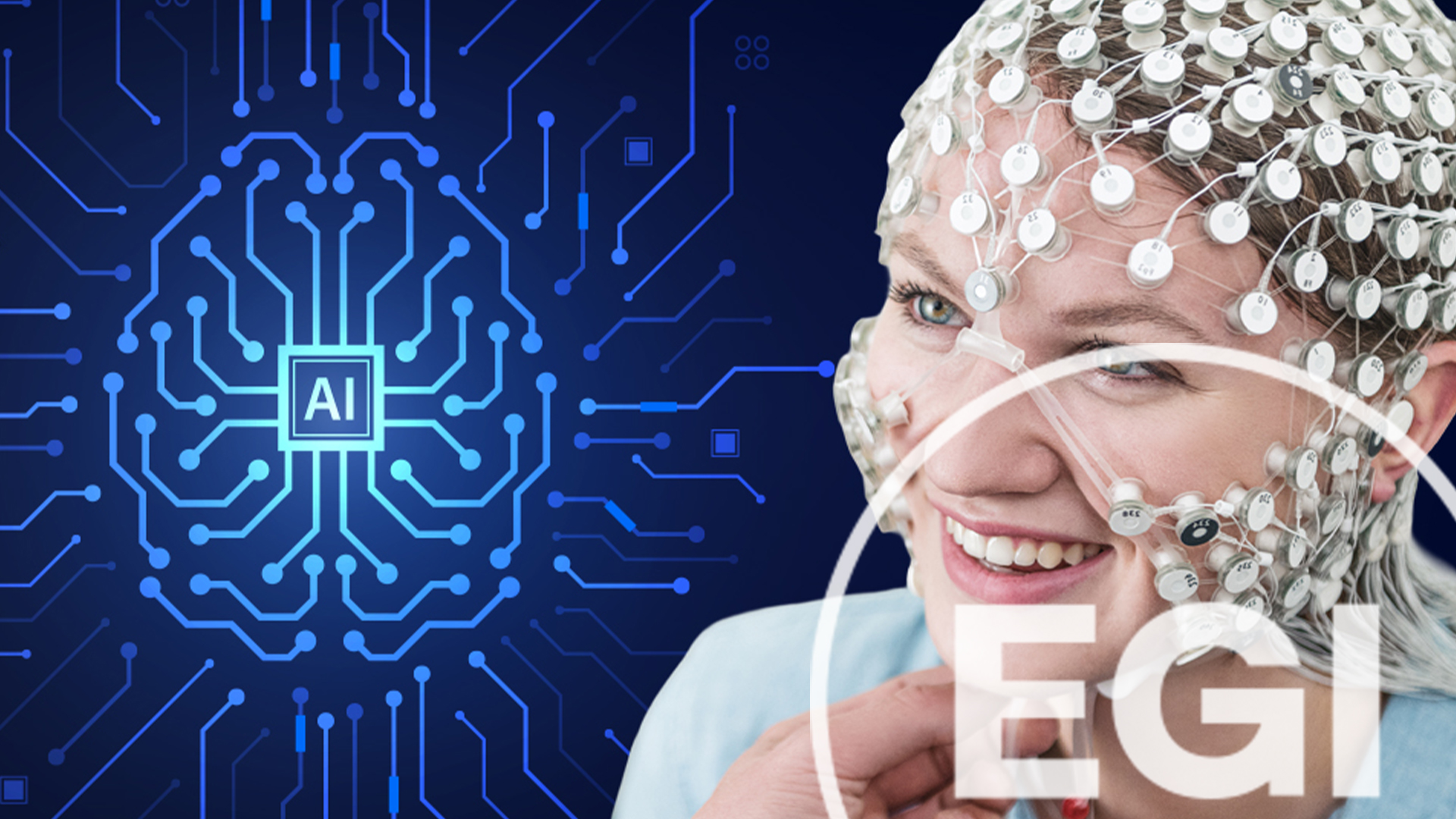
The field of EEG is always evolving to meet the needs and challenges of the day. Over the last few years, unprecedented interest in the development and application of artificial intelligence and machine learning has impacted many areas of life, including the fields of neuroscience and psychiatry, as people hope to understand and interact with the brain using these new tools.
Some EEG applications, like collection of robust-well-studied cognitive brain responses, don’t require as many electrodes as they once did. When a new field or question arises, it is always good to start with a rich, high-resolution model to assess options for a simpler option for collecting the data you need. Detailed below, and in following posts, we offer examples of how High-density EEG (HD-EEG) is the optimal tool for those interested in artificial intelligence and machine learning as it provides the data quality and resolution required to build accurate, generalizable, and robust models.
Key features of HD-EEG for artificial intelligence (AI) and machine learning (ML) applications:
1. Rich Spatial Information
- HD-EEG captures brain activity from up to 256 locations across the scalp, providing detailed spatial patterns of neural signals.
- This allows machine learning models to:
- Detect subtle regional differences in brain activity.
- Learn spatially distributed features related to specific cognitive states or pathologies.
- Improve source localization, helping algorithms connect EEG signals to underlying brain regions.
2. Improved Signal Quality for Temporal Analysis
- More electrodes help suppress noise through spatial filtering (e.g. Common Average Referencing).
- This leads to:
- Cleaner time-series data for temporal modelling (e.g. RNNs, transformers).
- Better event-related potential (ERP) detection.
- More accurate time-frequency decompositions (important for feature extraction).
3. Enabling Complex Pattern Learning
- AI and ML perform best on high-dimensional, structured data.
- HD-EEG offers more input features (channels × time), which:
- Enables training of deep learning models that can learn both spatial and temporal dependencies.
- Helps distinguish between subtle brain states (e.g. different emotions, levels of attention or mental fatigue).
4. Ground Truth for Model Validation and Simplification
- HD-EEG can act as a gold standard to:
- Train and validate models that are later deployed on low-density or wearable EEG systems.
- Simulate what information is lost when reducing channel count and use AI to reconstruct or infer missing data.
5. Better Generalisation, Feature Engineering and Labeling
- The larger spatial detail of HD-EEG helps mitigate individual anatomical and signal variability.
- In research, HD-EEG is often combined with behavioural tasks and clinical outcomes, producing high-quality labelled datasets. These datasets are crucial for supervised ML and for building explainable AI models.
Summary:
HD-EEG enables the training of models with detailed, high-resolution input to learn accurate patterns. Once the model has been trained, it can be used for lower density or mobile applications. Using HD-EEG reduces the risk of underfitting due to limited input features and overfitting to noise. This is essential to accurately detect spatial patterns and to generalise across subjects or conditions.
Fact:
EGI (Electrical Geodesics, Inc.), now part of Magstim, pioneered high-density EEG (HD-EEG) technology with the introduction of the Geodesic Sensor Net in the early 1990s. This non-invasive system allows for rapid application of up to 256 sensors without the need for abrasion or conductive gels, making it ideal for research across the lifespan and in varied clinical and cognitive neuroscience settings. EGI technology has been cited in more than 5,000 peer-reviewed research publications, with neuroscience researchers choosing EGI HD-EEG for its high spatial resolution, fast setup time, and proven ability to capture detailed brain activity with exceptional accuracy and comfort for participants.
Marketing Doc No: MK2413 -01